
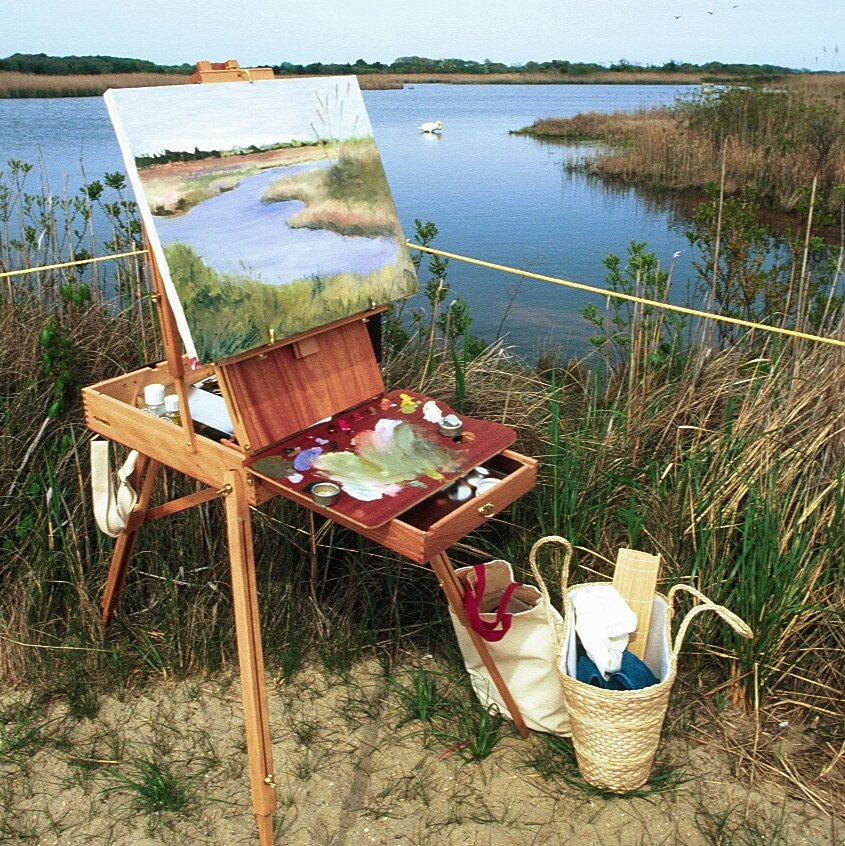
Ever since I had my first plain aire experience with Gerry Heydt in Cape May at her workshop several
years ago, I have been telling my photography students… if you think you know how to see, you need
to take a plein aire painting class. Some actually listened to me and I have gotten really good feedback.
I know it changed my life to try something that hard and to step out of my comfort zone just to see what
happens. I learned how to see in a new way. For sure as a lifer in the photography world, I know how to
see but this taught me something else. This was learning how to see like a painter. This was different.
There are so many subtle things that the rushing photographer doesn’t notice. That windy day at the beach taught me to see the finer distinctions of color and that there is a lot more purple out there than I could ever have imagined and certainly several greens.
I am quite grateful for that unique experience and laugh about it now when I describe it to my photography students. But that experience was very meaningful to me at this stage of my visual career. It also gave me a great deal of respect for anyone who does this on a regular basis. It takes real passion. It’s really hard.
To just give you a word picture of my experience: I had no hat so my long hair was whipping around in
my face all day. My ears and face got burned to a crisp. Glad I brought my bug spray. Those Jersey flies
can carry you away. Would have loved to use it on one of those sidewalk critics. These people just keep
talking. And for Pete’s sake, stop asking me where the public bathroom is. Do I look like an information
booth? Is this really how Monet got his start? I should have a sign made up for the easel not to bother the painter. Could I really call myself that? Am I a painter?
It took me several minutes to set up that crazy three-legged thing you guys call an easel. Those damn little legs just go in every direction. I have to say that our tripods are a lot more civilized. I finally got all my brushes and mediums out and somewhat organized but I discovered that I had no paints. In the packing frenzy to leave for Cape May, I must have left them at home. My friend Gerry squirted a bunch of colors out for me in the true spirit of sharing and I was ready to go.
For some reason, a 16×20 canvas seemed the right size to me. It is a normal size for my finished framed
photographs. However, I think it might have been considered really big for my first plain aire oil
painting….I didn’t know that for sure but after looking at the rest of the set-ups with puny little canvases, my suspicion was confirmed. She let me continue without criticism. She gave me only one green. I was starting to see several greens in my frustration to only look at one picture for an extended period of time.
By now I would have shot at least 30-40 pictures. To say this whole operation was frustrating would be an understatement.
I mentioned to her that I only had one green. There seemed at the time to be at least two or three more out there from my point of view. I pointed that out to her and she grabbed my brush that I was clutching so tightly that my fingers needed to be pried off of it, and without a sound she quickly mixed up about 5 more
greens with just a few swishes. I was really impressed. I started to look even harder at the landscape to see
if I could see where all those greens might be that were now mixed for me. She obviously must think they
are there. I think I see another one in the shadows.
It occurred to me that I never really thought about how a painter has to look at a three dimensional scene
and translate it to two dimensions. Wow. This is big. My camera always did that automatically for me.
I now had to process this information through my eyes, to my brain and then have something beyond a
stick figure appear on the canvas. What a revelation that was. I tried to sketch out the scene and really look
at perspective, then add color. But wait, the light is different and the clouds are now in a different place
from when I started. My whole world is based on light but I never had to deal with it like this before. It all
happens so slowly. How do you get the shadows going in the right direction and the clouds are now gone
that I started with. This is really hard.
This exercise went on for five hours. Every time I looked up the clouds were in a different place. How are
you supposed to deal with that? I kept looking….oh my God, so much looking. I couldn’t believe it. I
could have shot several hundred pictures by now…. but there I was still with an unfinished painting of the
same scene, sunburned and exhausted. My back hurt because you really can’t sit down even though I had
dragged a chair along thinking about a relaxing day painting with my new friends. That thought is now
history. You have to step away from the painting quite often to get a better look at it all, so no one was
sitting and I didn’t want to appear like a wuss. My feet hurt, my brushes practically needed to be surgically
removed from my left hand. I was so afraid of dropping them in the sand. I think I had more paint on my
clothes than on the canvas. Everything had to be folded up before it got dark. Dark? Could I really have
been here that long? The mosquitoes are starting to bite now. I have to carry all this stuff back to the car
and the brushes still need to be cleaned. All that looking, prepping, fly swatting and schlepping and the
thing wasn’t finished yet. How can that be?
One of the more experienced painters in the group had her whole set up take flight in the middle of this
ordeal. She had a pretty umbrella attached to her easel and with one gust of wind the whole thing took off.
I was horrified. How awful. Of course the whole business landed jelly side down. I felt her pain but tried to
console her by saying…well gee, it was a painting of the beach, now it had some real texture. I don’t think
that she appreciated my concern.
It took me three years to finish that damn painting. The really cool part is that the next year, I was much
faster at setting up the collapsible easel and put the same painting back up on it since we were at the same
location. After a little time went by and you naturally start looking at what the others were doing, the rest
of the students were quite impressed that I was so far along with such a big canvas.
By the third year, I was feeling even better about the whole thing….the painting was almost finished!!! I
decided that I had probably reached my max in the painting world and should quit while I was ahead. I
have since done some more painting and it has launched a whole new body of work where I paint on my
inkjet photographs.
All in all, it was a great experience that could not have been predicted. I wanted to take the plunge into
new territory and it was great. I am suggesting that if you are a painter that you take the plunge into
photography and see where it goes. And if you are a photographer, take the plunge into painting. Just let
yourself go. You might be surprised about what you would learn from the other medium. Give it a shot.